
Smartway Labs
Most golf simulator businesses lose money in the same quiet place: the gap between “a customer wants to book” and “a customer is standing inside the bay.” Calls go unanswered after hours. Booking data lives in one system, door access in another, the CRM in a third, and a staffer runs between all of them. And when it’s 11 PM on a Saturday and a customer can’t get out of the bay, or their screen won’t turn on, there’s no one to call.
REMO Golf came to us with exactly this problem. Bookings were happening, but the operational glue holding it all together was human time, and human time doesn’t run at 11 PM on a Saturday.
So we replaced the glue. Quiet automation took on part of the work, and an AI agent took on the conversations with an infrastructure built around it that you can actually trust.
What runs with no AI at all
When a customer books through Skedda, our integration layer generates a TTLock access code for the exact reservation window and sends it via Twilio (SMS + email). It never touches a human. The AI shows up where the conversation begins when something goes off-script.
What the customer sees
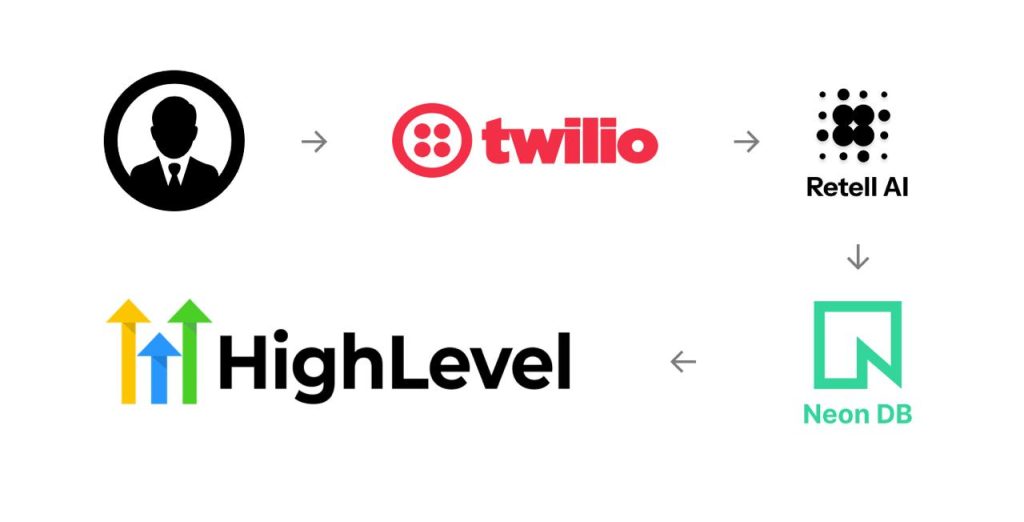
The voice AI agent (RetellAI + Twilio) picks up the phone at any time of day, night, or weekend. It handles everything that happens after the booking:
- Confirms existing reservations – instantly verifies details when a customer calls in
- Re-issues access codes – when a customer loses the SMS, can’t find the email, or calls from a different number than the one the confirmation went to
- Changes booking details by voice – extend time, move a slot, cancel
- Runs real-time technical diagnostics – projector won’t turn on? Lock jammed? Sound cut out? The agent walks the customer through a step-by-step checklist
- Resolves common situations on its own – “forgot my access code,” “how do I get out of the bay,” “the lights went out,” “can’t launch the game.”
- Escalates to an operator only what genuinely needs hands
This isn’t “we’ll call you back” for the sake of a metric. It’s technical support that closes real problems inside the bay, which is why the system is designed so that most calls never reach a live operator at all.
Before: a customer is in the bay at 10:30 PM, the projector won’t start, and no one’s at the front desk. After: the AI picks up, walks them through a restart, problem solved in 90 seconds, and the owner finds out about it in the morning report.
What the owner sees
An AI that doesn’t report back is a black box that the owner stops trusting within two weeks. So every conversation lands automatically in the client’s CRM (GoHighLevel) as a contact and an opportunity, tagged by stage:
- AI Resolved closed by the agent
- Operator Escalated to a human
- Not resolved needs attention
The owner opens a familiar dashboard and sees that a quiet Saturday night brought, say, 11 resolved cases and 0 missed calls with no report exports. It’s configured per-location, so each venue has its own CRM account and its own picture.
On top of that sits a custom dashboard with intent analytics, resolution charts, transcript review, and call recordings. You see not just how many customers call, but what they call about.
How we guarantee quality: an AI tester that runs every case itself
This is where we do what 99% of voice AI deployments don’t.
Most teams test a voice agent manually on a dozen calls and pray nothing breaks. We built an AI tester, a separate system that calls the agent itself and runs every case instead of a human. Every time we change the conversation logic, this tester runs through:
- 26 synthetic customers – different voices, temperaments, levels of verbosity, 2 languages
- 16 typical scenarios – from “forgot the code” to “can’t get out of the bay,” “lights went out,” “screen won’t turn on”
- automatic scoring across 4 criteria – intent recognition, resolution, correct tool usage, conversation tone
If the average score dips, the release doesn’t ship. It’s an engineering bar serious SaaS products are built on.
The infrastructure under the hood
We deliberately built on a stack REMO already trusted rather than forcing a rip-and-replace. The scale of what’s actually been built:
- Skedda – booking as the single source of truth
- RetellAI + Twilio– voice agent and telephony
- TTLock – door access tied to the exact reservation window
- GoHighLevel – CRM bridge with a per-location pipeline
- Zapier in a sub-zap architecture – one central workflow called by every location
- A custom orchestration layer on serverless infrastructure (Vercel) – 28 secured integration points under a single auth layer
- A conversation flow of 182 nodes – not a linear script, but a branching tree across 6 scenario groups (access, equipment, booking, time extensions, food/drinks, climate), in two synchronized language flows
The sub-zap architecture has a direct business consequence: opening a new location takes hours, not weeks of reconfiguration.
And time-limited access codes aren’t just convenient, they’re a security gain: no “forgotten code” floats around with customers after the session ends.
The takeaway for any service business
You probably don’t need a bigger team. You need your systems to hand the customer off to each other without a human in the loop and an AI layer to close the conversations that used to require a front desk. That’s the difference between automation that looks impressive in a demo and automation that quietly pays for itself every weekend.
Smartway Labs builds AI, voice, and automation systems for businesses that want to scale operations without scaling headcount. If you see your business in this description, get in touch, and we’ll show you our architecture in 20 minutes.