
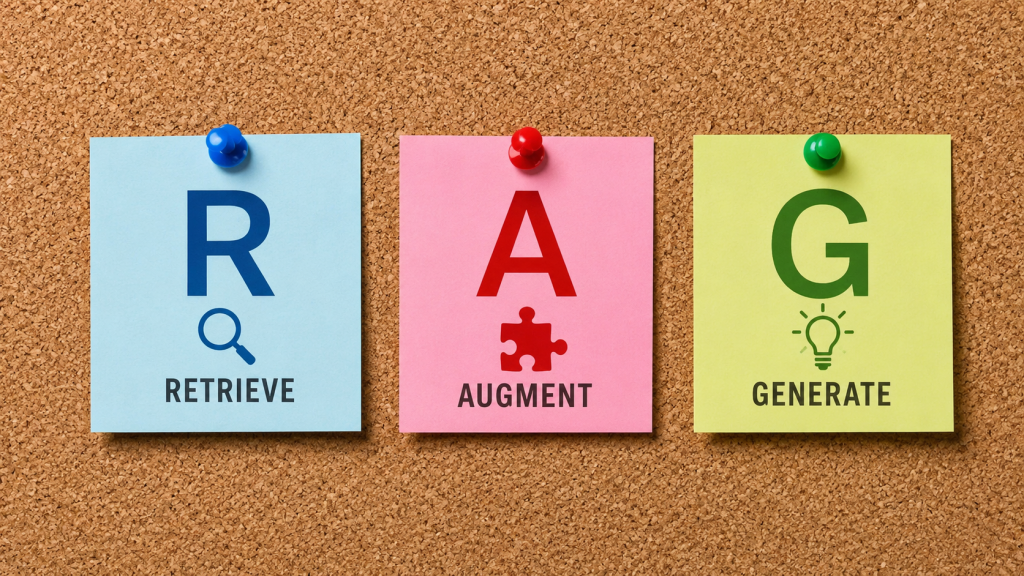
Most AI systems answer questions based on what they learned during training, a fixed snapshot of information that becomes stale the moment it is created. RAG changes this. It gives AI systems the ability to retrieve current, specific information at the moment it is needed, making them accurate, trustworthy, and genuinely useful for business applications where the training data alone is never enough.
In this article
- What RAG actually is in plain language
- Why standard AI models fall short for business use
- How RAG works, step by step
- Where RAG creates the most business value
- RAG vs fine-tuning: which approach is right
- What a production RAG system actually requires
RAG – Retrieval-Augmented Generation has become one of the most practically important concepts in business AI, but the name obscures what it does. It is not a model. It is not a product. It is an architectural pattern, a way of connecting an AI language model to a knowledge source so it can give accurate, current, specific answers instead of plausible-sounding guesses based on outdated training data.
1. What RAG actually is in plain language
A standard AI language model is like a very well-read person who has not looked at anything new in the past year. Ask them a general question, and they will give you a confident, coherent answer. Ask them about your specific product catalogue, your current pricing, your internal policies, or what happened in your industry last month and they will either guess, hallucinate, or tell you they do not know.
RAG solves this by giving the model a search step before it answers. Instead of answering purely from memory, the model first retrieves the relevant information from a connected knowledge source, your documentation, your database, your product catalogue, your internal wiki, and then uses that retrieved information to construct its answer.
The result is an AI system that answers questions about your specific business, with your specific information, accurately and currently rather than one that answers general questions well and your specific questions poorly.
The analogy that makes it click
Think of RAG as the difference between asking a colleague a question from memory and asking a colleague who can look things up before answering. The colleague with access to the right documents gives you a better, more accurate answer not because they are smarter, but because they are working with better information at the moment they respond.
2. Why standard AI models fall short for business use
The limitations of standard language models for business applications come from the same source as their strengths: they were trained on a vast, general corpus of information up to a specific date. This makes them excellent at general reasoning, writing, and explanation and poor at anything that requires current, specific, or proprietary knowledge.
- Training data goes stale. A model trained six months ago does not know about your product updates, pricing changes, policy revisions, or market developments since then. For business applications where accuracy matters, this is a significant limitation.
- They do not know your business. Your internal documentation, your specific processes, your product specifications, your customer history, none of this is in the training data. A standard model answering questions about your business is improvising, not informing.
- They hallucinate. When a language model does not know the answer, it does not reliably say so. It generates a plausible-sounding response that may be factually wrong. In a business context, answering a customer question about a product, providing policy information to an employee, and summarising a contract, hallucinations are not an acceptable failure mode.
3. How RAG works, step by step
1
The user asks a question. A customer asks about your refund policy. An employee asks about the process for onboarding a new supplier. An agent needs to know the current availability of a product.
2
The system searches the knowledge base. Instead of going straight to the language model, the system first searches your connected knowledge sources, documentation, databases, product catalogues, policies, and previous conversations for the most relevant information.
3
The relevant content is retrieved. The most relevant chunks of information are pulled from the knowledge base and assembled into a context that will be passed to the language model alongside the original question.
4
The model generates an answer using the retrieved context. The language model now answers the question using both its general reasoning capability and the specific information just retrieved. It is told to base its answer on the provided context, which dramatically reduces hallucination.
5
The answer is returned, grounded in real information. The user receives an answer that is accurate, current, and specific to their business, not a general response based on training data that may be months or years out of date.
4. Where RAG creates the most business value
Customer support AI Answering product and policy questions accurately
A customer support AI built on a standard model will answer general questions about your product category but will improvise on your specific pricing, your specific warranty terms, your specific return policy. A RAG-powered support agent retrieves the actual current information from your knowledge base before answering. The difference in accuracy and in the trust customers place in the responses is substantial.
Internal knowledge assistant Surfacing information across internal documents
Most organisations have significant institutional knowledge scattered across wikis, shared drives, Confluence pages, email threads, and meeting notes. An internal knowledge assistant powered by RAG lets employees ask questions in natural language and get accurate answers drawn from the actual documents rather than spending thirty minutes searching across five different systems. The productivity gain compounds across every employee who uses it daily.
Sales and product A.I. Accurate answers during sales conversations
Sales teams frequently face product questions they cannot answer immediately: technical specifications, compatibility questions, pricing edge cases, integration capabilities. A RAG-powered assistant connected to the product catalogue and technical documentation gives accurate, current answers in real time, reducing the “let me get back to you” moments that interrupt sales conversations and delay decisions.
Contract and document intelligence: Querying large document sets accurately
Legal teams, compliance functions, and procurement departments regularly need to answer questions that require reading across large numbers of documents, “Does any supplier contract include a price escalation clause?”, “Which agreements expire in Q1 next year?”. RAG makes this queryable in natural language with answers grounded in the actual document text, rather than requiring manual review or expensive search implementations.
5. RAG vs fine-tuning: which approach is right
When businesses want to make an AI model more knowledgeable about their specific domain, two main approaches are available: RAG and fine-tuning. They are often confused but serve different purposes.
| Factor | RAG | Fine-tuning |
|---|---|---|
| What it does | Connects the model to a knowledge source at inference time | Trains the model on domain-specific data to change its behaviour |
| Knowledge currency | Always current knowledge base updated independently of model | Fixed at training time — stale until retrained |
| Cost | Lower no model training required | Higher requires significant compute and data preparation |
| Best for | Factual accuracy, current information, and proprietary knowledge | Style, tone, domain-specific reasoning patterns |
| Hallucination risk | Lower answers grounded in retrieved documents | The higher the model still generates from learned patterns |
| Implementation speed | Faster connect and configure | Slower data preparation, training, and evaluation cycle |
For most business applications customer support, internal knowledge, product Q&A, document intelligence — RAG is the right starting point. It is faster to implement, cheaper to run, and produces more accurate factual answers than fine-tuning. Fine-tuning becomes relevant when you need to change how the model reasons or communicates, not just what information it has access to.
6. What a production RAG system actually requires
RAG sounds simple in principle — retrieve, then generate. In production, the quality of the system depends on several components that are easy to underestimate:
- Knowledge base quality and structure. RAG is only as good as the documents it retrieves. Outdated documentation, inconsistent formatting, duplicate content, and missing information all degrade output quality. Before building an RAG system, the knowledge base needs to be audited and cleaned.
- Chunking and indexing strategy. How documents are split into retrievable chunks significantly affects whether the right information is retrieved for a given query. Poor chunking, too large, too small, or split at the wrong points, is one of the most common causes of RAG systems that seem to work in testing but fail on real queries.
- Retrieval accuracy. The search step that finds relevant documents needs to be tuned to your specific content and query patterns. Out-of-the-box retrieval works for general cases; production accuracy requires evaluation and refinement against real queries from real users.
- Citation and transparency. Production RAG systems should be able to show users which documents their answers came from, allowing verification and building trust. Systems that generate confident answers without source attribution are harder to audit and harder for users to trust.
- Keeping the knowledge base current. A RAG system is only as current as the documents it retrieves. A process for updating the knowledge base as documents change and for removing or superseding outdated content needs to be part of the system design, not an afterthought.
At SmartWayLabs, RAG is now a standard component of most AI systems we build for clients, from customer support agents to internal knowledge tools to document intelligence platforms. The knowledge base preparation and retrieval tuning stages are consistently the most important determinants of output quality, and the ones that most often get underestimated in initial scoping.
The bottom line
RAG is what makes AI systems genuinely useful for business applications where accuracy, currency, and specificity matter. A standard language model answers general questions well. A RAG-powered system answers your specific questions accurately, drawing on your actual documentation, your current information, and your proprietary knowledge.
For any business AI application where the quality of the answer depends on knowing your specific products, policies, processes, or data, RAG is not an optional enhancement. It is the architectural foundation that determines whether the system is trustworthy in production or impressive only in a demo.
If you are building or evaluating an AI system for your business and want to understand whether RAG is the right approach for your use case and what it would actually take to implement the SmartWayLabs team is happy to talk it through with you.
Building an AI system that needs to know your business?
SmartWayLabs builds production RAG systems that give your AI accurate, current answers drawn from your actual knowledge, not generic training data. Talk to the team ↗