
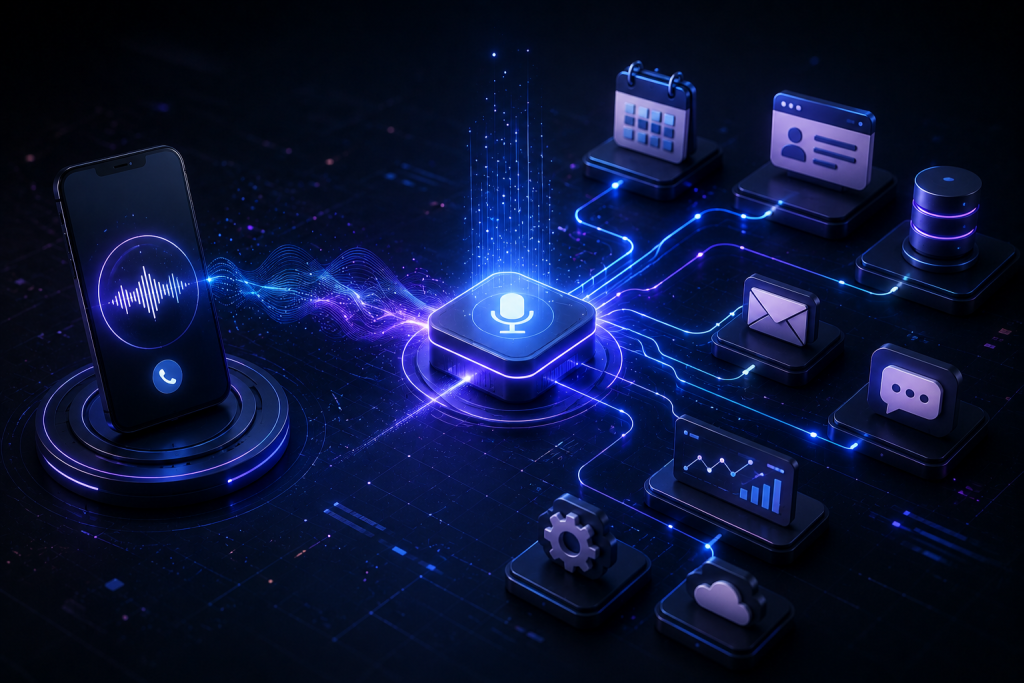
Voice AI has moved well past the robotic phone menu. The systems being deployed in 2026 understand natural conversation, handle complex multi-intent calls, and connect directly to the business systems they need to act on. Understanding where the technology is now and where it genuinely creates value versus where it still falls short is what separates useful deployments from expensive disappointments.
In this article
- What voice AI can reliably do in 2026
- The industries deploying it at scale
- How voice AI connects to business automation
- What separates production-ready from demo-ready
- Build vs buy: the decision that determines your ceiling
The gap between voice AI demos and voice AI in production has narrowed significantly over the past eighteen months. What was genuinely difficult two years ago, handling regional accents, managing mid-sentence topic changes, and integrating with live business systems, is now reliably achievable with the right architecture. The question for most businesses is no longer whether voice AI can handle their calls, but whether the implementation they are considering is built to production standards or optimised for a convincing pilot.
1. What voice AI can reliably do in 2026
Production voice AI systems in 2026 reliably handle a well-defined set of capabilities that cover the majority of inbound call volume for most business types:
- Multi-intent call handling. Callers rarely have a single, clean request. They call to reschedule an appointment, ask about a bill, and mention a symptom, all in the same call. Modern voice AI tracks multiple intents within a single conversation and routes or handles each appropriately.
- Live system integration. The agent checks real calendars, reads actual account information, writes confirmed bookings, and updates live records, not simulated data. The integration layer is what determines whether the agent is actually useful or just conversational.
- Accent and speech variation. Current speech recognition handles regional accents, background noise, interrupted speech, and non-native speakers significantly better than earlier systems. This was one of the primary failure modes of voice AI two years ago it is no longer the primary concern for most deployments.
- Graceful escalation. When a call moves outside the agent’s scope — a complaint, a complex query, an emergency the system transfers the call to a human with full call context passed across, so the caller does not have to repeat themselves.
- After-hours operation. The agent handles calls when no staff are available, booking appointments, taking messages with structured information extraction, and providing account information, generating value from inbound volume that would otherwise be missed entirely.
What it still does not do reliably
Voice AI in 2026 still struggles with highly emotionally charged conversations, complex legal or financial advice, and calls that require genuine empathy and human judgment. It is not a replacement for human agents on high-stakes, high-emotion interactions; it is an augmentation that handles the routine volume so human agents can focus on the calls that genuinely need them.
2. The industries deploying it at scale
🏥Healthcare and dental practicesHealthcare
Appointment booking, rescheduling, prescription refill requests, and basic triage questions. The agent handles the routine seventy percent of inbound call volume, freeing front-desk staff for patients physically in the practice and for the calls that require clinical judgment.
Typical result: 60–70% of call volume handled without staff involvement. Missed call rate drops to near zero.
🏢Financial services and insuranceFinance
Account balance queries, payment processing, policy information, claim status updates, and appointment scheduling with advisors. Compliance requirements add complexity: all calls must be logged, certain disclosures must be made, and escalation to a regulated human advisor is mandatory for certain query types. These requirements are buildable but must be designed in from the start.
Typical result: significant reduction in routine query volume to human agents, with compliance logging automated.
🏠Property and real estateProperty
Inbound property enquiries, viewing scheduling, tenant maintenance requests, and landlord communication. The after-hours use case is particularly strong. Prospective buyers and tenants frequently call outside business hours, and a voice agent that can qualify the enquiry and book a viewing at 9pm converts leads that would otherwise be lost until the following morning.
Typical result: after-hours lead capture increases significantly. Viewing scheduling admin reduced by over half.
🚚Logistics and field servicesOperations
Delivery status updates, collection scheduling, driver dispatch coordination, and customer notification calls. Voice AI handles the high-volume, low-complexity call types that consume dispatcher time, leaving human dispatchers for the exceptions that require real-time judgment.
Typical result: dispatcher call volume reduced by 40–50% on routine enquiries.
📞Sales and outbound qualificationSales
Outbound qualification calls to warm leads, appointment confirmation calls, and re-engagement calls to lapsed customers. Voice AI on outbound requires careful design; the interaction must feel natural, and the value proposition must be clear within the first few seconds. When done well, it allows sales teams to focus entirely on qualified conversations rather than qualification calls.
Typical result: sales team time on unqualified calls reduced significantly. Pipeline quality improves.
3. How voice AI connects to business automation
A voice agent that can hold a conversation is a consumer product. A voice agent that can take action, writing to your CRM, updating your scheduling system, triggering your billing platform, and sending a confirmation email is a business automation tool. The difference is entirely in the integration layer.
The businesses getting the most value from voice AI in 2026 are not treating it as a call-handling tool. They are treating it as an automation entry point, the voice channel through which business processes are initiated and completed, just as web forms and chat interfaces serve the same function in other channels.
When a patient calls to reschedule an appointment, the voice agent does not just take a message. It checks the live calendar, offers alternatives, confirms the booking, updates the practice management system, sends a confirmation SMS, and logs the interaction, all within the call. The call is the interface. The automation is the value.
| Call type | Voice AI handles | Business automation triggered |
|---|---|---|
| Appointment request | Natural language booking conversation | Calendar check → booking written → confirmation sent → reminder scheduled |
| Account query | Identity verification, query handling | Account record accessed → response generated → interaction logged |
| Complaint | Initial information gathering | Ticket created → priority assigned → human agent briefed → callback scheduled |
| Payment processing | Amount confirmation, payment method | Payment gateway called → receipt generated → account updated |
| Maintenance request | Issue description and urgency assessment | Work order created → engineer assigned → customer notified of ETA |
4. What separates production-ready from demo-ready
A voice AI that sounds impressive in a thirty-second demo is not necessarily one that performs under the conditions of a real business day: variable call quality, background noise, callers who interrupt, callers who change their minds mid-sentence, callers in emotional distress.
The markers of a production-ready voice AI system:
- It has been tested on real call recordings from your environment, not clean studio audio. Accent handling, background noise tolerance, and speech pattern recognition all need to be calibrated to your actual caller population.
- It has a defined, tested escalation path. Every scenario that should route to a human is mapped, tested, and confirmed to work, including the edge cases that only appear under real call volume.
- It integrates with live systems, not test environments. The system has been tested against real API responses, real rate limits, and real edge cases in the data it works with, not a sanitised test dataset.
- It has monitoring and alerting in place before go-live. Call quality metrics, escalation rates, completion rates, and error rates are tracked from the first live call, not reviewed for the first time when a complaint surfaces.
- It has been run in parallel with existing call handling. A defined parallel period where the agent handles calls alongside existing processes, with daily comparison of outcomes, before the agent takes over the primary volume.
5. Build vs buy: the decision that determines your ceiling
The voice AI market in 2026 offers two broad paths: off-the-shelf platforms that provide configurable voice agents with predefined capabilities, and custom-built voice agents built specifically around your workflows, systems, and user population.
| Factor | Off-the-shelf platform | Custom-built agent |
|---|---|---|
| Time to deploy | Weeks | 2–4 months |
| Integration depth | Limited to the platform’s supported integrations | Fill any system with an accessible API |
| Conversation design | Constrained by platform templates | Fully customized to your workflows |
| Ongoing cost | Per-minute or per-call pricing — scales with volume | Fixed infrastructure cost regardless of volume |
| Compliance control | Dependent on the platform’s compliance posture | Full control over data handling and storage |
| Performance ceiling | Limited by platform roadmap | Unlimited evolves with your requirements |
For most businesses, the right starting point is to trial an off-the-shelf platform for a well-defined use case — after-hours call handling, appointment reminders, basic query resolution. This provides fast value and real data about where the platform’s ceiling is for your specific needs. When the platform’s limitations become the constraint, a custom build becomes the appropriate investment.
At SmartWayLabs, we have built production voice AI systems across healthcare, property, and professional services and we have also advised clients to start with an off-the-shelf platform when the scope did not justify a custom build. The goal is always the right solution for the specific situation, not the most technically impressive one.
The bottom line
Voice AI in 2026 is a mature enough technology to deploy with confidence for well-defined use cases but immature enough that the implementation quality still determines the outcome more than the underlying technology does. The businesses getting the best results are the ones that build for production from day one, integrate with live systems rather than simulated data, and treat the voice channel as an automation entry point rather than a call deflection tool.
The gap between a voice AI that handles calls and one that drives business automation is almost entirely in the integration layer and that is the part that requires the most careful design.
If you are evaluating voice AI for your business, whether that is a specific use case like appointment booking or a broader automation goal, the SmartWayLabs team is happy to give you an honest assessment of what is achievable, what it would take to build, and whether an off-the-shelf platform or a custom system makes more sense for your situation.
Thinking about voice AI for your business?
SmartWayLabs builds production-ready voice AI systems integrated with your live systems and designed for real call conditions, not just demos. Talk to the team ↗